Antivax chiros and accountability – as evasive as a subluxation
A few Thursdays ago, chiros in Australia copped a bollocking on Catalyst as Dr Maryanne Demasi turned a spotlight on their profession.
And it wasn’t pretty. What resulted was examples of quackery, infighting between professional bodies and the revelation that chiro does not have an adverse events (AE) reporting system.
You can watch the full report and read the transcript here
I want to emphasise the lack of an AE reporting system, because you often hear the cry from chiros that their profession is overwhelmingly safe, which is usually followed by some strawman about the numbers of iatrogenic deaths in science based medicine. But how do they know their profession is safe if they don’t record adverse events?
Well, to be blunt they don’t.
Even before the programme aired on Thursday night, many chiros had hit the Catalyst FB page, in a pre-programme show of support (perhaps as result of an email that had been sent by the Chiropractic Association of Australia (CAA) to all chiros warning them about the impending criticism).
I decided to jump in too because I had a burning question that had been bugging me for weeks. It concerns the vaccination status of paediatric chiros and occurred to me when I saw some pictures of chiropractors leaning over very young children to adjust them or whatever they do.
This worries me for several reasons, 1) Australia has been in the grips of a pertussis epidemic and kids have died 2) it’s thought that it is adults who are passing on the bacteria because their vaccination has worn off (pertussis vaccination only lasts between 4 and 8 years) and 3) kids under the age of 12 months are most likely to suffer and die from infection with pertussis given that they are not fully vaccinated thus they’re not protected.
Also by way of background, there are two professional associations for chiros in Australia, the CAA who previously had no policy in vaccination but published one (of sorts) in May 2013.
It’s pretty wishy washy in my opinion,
“Chiropractors do not provide vaccination services; Chiropractors should encourage their patients to make informed health care decisions and to consult their GP in relation to the risks and benefits of vaccination.”
The other being the The Chiropractic and Osteopathic College of Australasia (COCA) who are quite clear about their stance on vaccination,
“(COCA) endorses the Government of Australia’s policy and position on immunisation as a simple, safe and effective way of protecting people against harmful diseases.”
The full policy can be found here (PDF)
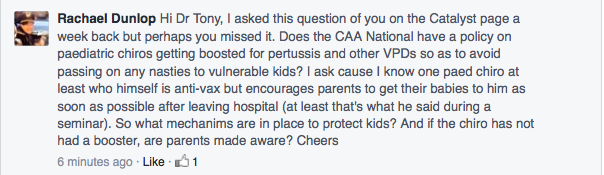
So I had a burning question for paediatric chiros, concerning duty of care for babies and what steps they take to ensure they’re protected during manipulations. I ask this because my guess is if the chiros themselves are anti-vaccination then it seems unlikely they will be diligent about getting boosters, but I could be wrong and I hope I am.
Well known to readers of this blog is anti-vaccine paediatric chiropractor, recently the secretary of the CAANSW, Nimrod Weiner, and who has published several pictures of himself leaning over babies whilst adjusting them on his Facebook page.
Nimrod Weiner declined to comment on the Catalyst episode, (even though a complaint made about his anti-vaccine material was mentioned) so I started off by commenting on a post made by Dr Tony Croke, who says on his website that he “..is skilled in cranial adjusting techniques, which are often very helpful for babies and children”.
He has also previously been a professional member of the anti-vaccination lobby group the AVN (details – well, sort of – here). He is also on the National Board of the CAA, who approved a continuing professional development course by notorious anti-vaccine chiro Tim O’Shea (see coverage here).
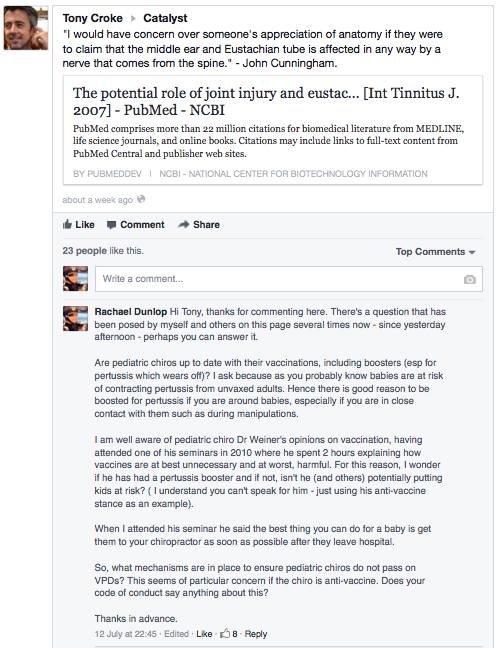
Note the time stamp, 22:45, 12th July, 2013.
I had no luck sadly, so I posted a new thread on July 13th at 00:05

When still no chiropractors commented, my friend Annette had a go

Eventually a chiropractor by the name of Steele Butcher jumped in with this

Let me repeat that,
“As with many professions politics get in the way.”
Politics gets in the way of duty of care to babies. Babies who cannot fend for themselves and are susceptible to vaccine preventable disease which could so easily be prevented if the CAA had the balls to tell their paediatric chiros to get boosted (if they are not, once again I hope I am wrong).
This was my response to Steele.
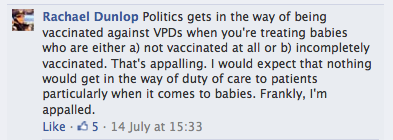
Let me make this as clear as possible.
I am not accusing anyone of infecting kids with pertussis. I am seeking an answer to the question, “if you’re working with kids are you considering their welfare by having a booster?”.
On the surface this seems like a simple question but over a week later it remains unanswered by any chiros – at least the ones that flooded the Catalyst FB page anyway.

You can read the entire thread here if you’re interested. Not that it offers any answers.
So we remain none the wiser about the duty of care of paediatric chiros to vulnerable kids who are at risk of contracting any number of infections from adults who have not been boosted for VPDs. On another thread I asked the chiros what their code of conduct had to say about this and once again this.
I have been to seminars given by paediatric chiros before, in fact ones on the topic of vaccination where I’ve listened to chiros tell parents to get their kids to a chiro as soon as possible after leaving hospital. Within hours if possible.
But at what risk? In medicine, decisions about interventions are determined based on a risk versus benefit ratio. For example, there is a risk in undergoing surgery but if the benefit of removing a tumour or whatever the problem may be, outweighs the risks, then people decide to do it.
But what about the risk ratio for paediatric chiro? Well, when the benefits are a a bit better than placebo, but the risks include sustaining an injury or a vaccine preventable disease, then it’s clear. Avoid it like the plague.
UPDATE: I’ve just asked the question of Tony Croke again.
AVN vs OFT : The Lulzfest
This week the AVN were in court challenging the order by the Office of Fair Trading to change their name.
Listen to the audio version of this on The Skeptic Zone
The OFT ordered them to do so, following multiple complaints from the public and subsequent changes to the Incorporated Association law earlier in the year enabling an order to be made.
The Minister for Fair Trading Anthony Roberts said; “The AVN’s name does not accurately reflect the organisation’s purpose and what it stands for, which is primarily to discourage the immunisation of children.”
The first step in challenging an order is an internal investigation (page 175 of GIPA here,) by the OFT and this was completed in February 2013.
The Principle Solicitor from the Department of Finance and Services concluded,
“All in all, the available evidence shows in my opinion that the AVN is mostly concerned with opposing vaccination and mandatory immunisation When issues have two sides, it takes just one of them. One would expect that am organisation with the name Australian Vaccination Network would provide comprehensives and credible information on vaccinations in Australia and a balanced view in what is involved in the process…the AVN does not do this”.
This AVN have been good at getting legislation changed recently. So far they’ve been instrumental in getting the HCCC laws changed (and as a result there is a current investigation into them), and the child care centre laws which may change again given they were silly enough to publicly proclaim everyone should join a church to get a religious exemption. As a direct result, pressure is being applied to close that loophole.
They’ve also been under fire from all angles including a continued attack from the Murdoch media who have only just begun to wind back their “No Jab No Play” campaign after more than a month. Even today there was another article about the AVN being investigated for fraud and not revealing their conflicts of interest.
But as you expect, the AVN didn’t agree with the OFT name change order so on Thursday and Friday they took the OFT to court to challenge the claim that their name is misleading.
You might think therefore that they would focus on composing an argument detailing why their name is not misleading in an effort to convince a magistrate, but we’re talking the AVN here so you’d be wrong, obviously. In addition that would be no fun.
Some members of SAVN were in attendance for the 1.5 day hearing and it is from their tweets and notes made by Shelley Stocken that I bring to you,
AVN vs OFT : The Lulzfest
I have Storified all the Tweets here if you want to read them in full.
Beginning at 2pm on Thursday our peeps noted that both Meryl Dorey and Greg Beattie were in attendance and the place was packed. There were also large cardboard laminated graphs, which, although never seen clearly, were thought to be the famous “vaccine preventable diseases declined prior to vaccines”. How these are revelant to a name change hearing is not clear but you’ll see the AVN tried to use them anyway. Her Honour was heard to repeat the word irrelevant many times throughout the course of the hearing.
There are large laminated graphs present. I AM EXCITED. #WAHpeal #StopAVN
— Shelley Stocken (@shellity) June 13, 2013
Much of the first day appears to have been taken up with faffing and obfuscation on the part of the AVN, none of which was relevant to the matter at hand – ie explain to us why you think your name is not misleading. Instead, the AVN barrister argued that SAVN were in cahoots with the government, that SAVN were big meanies, Freedom of speech or something, vaccines are not effective (I guess this explains the large graphs) and tried to admit new evidence including witnesses for the AVN.
Magistrate has a ‘get to the point’ look on her face #wahpeal — Maureen Chuck (@mochuckmochuck) June 13, 2013
AVN has witnesses present. OFT relying on papers. Her Honour happy to go with papers. #WAHpeal — Shelley Stocken (@shellity) June 13, 2013
One of these witnesses was thought to be Prof Brian Martin – supervisor of Judy Wilyman, to which her Honour said “What is he an expert in?”.
In reference to Brian Martin, Her Honour says “What is he an expert in?” #wahpeal — Shelley Stocken (@shellity) June 13, 2013
When the AVN tried to introduce Brian Martin’s evidence, the OFT lawyer objected saying his affidavit is totally irrelevant and he has no idea how it found is way into the court. In any case, evidence was to be presented in the form of affidavits not expert witness testimony. I wonder if Prof Martin caught the train up from Wollongong for nothing.
The AVN’s jabbering about people being mean to them on the Internet etc was quickly shut down by the Magistrate who stated says she is not interested in a “he-said-she-said” argument and whether Meryl thinks she is anti vax or not is irrelevant – it’s how she is perceived. After the AVN barrister mumbled something about their Code of Ethics preventing them from being anti-vax and everyone lolled for a bit, proceedings ended and the meanies from SAVN retired to the pub.
Waah waah skeptics are mean! No you idiots, you need to defend a misleading name for your inc. association or have it deregistered. #WAHpeal — Luke Weston (@lukeweston) June 13, 2013
Day 2
Day two opened with the revelation that Meryl Dorey had emailed the OFT barrister and the magistrate overnight apparently to complain about people live tweeting the proceedings.
Someone from the other side contacted the OFT barrister last night. #WAHpeal
— Peter Bowditch (@RatbagsDotCom) June 13, 2013
They tried to get live tweeting prohibited. Magistrate: I’ll put that aside for the while. #WAHpeal
— Peter Bowditch (@RatbagsDotCom) June 13, 2013
Look, IANAL but this seems like an extremely unwise thing to do. We can only hope that Meryl pulled a Freeman on the Land again, as she has done before when she was corresponding with the TGA. In any case the magistrate did not acquiesce to Meryl’s request to stop live tweeting. Yet the irony of Meryl attempting to quash live tweeting whilst constantly yelling FREE SPEECH has not escaped anyone here.
The AVN lawyer took one last punt at arguing about vaccination before being brutally rebuffed by the magistrate. Half a day and several hours later and finally we get to the evidence.
I have borrowed heavily from Shelley’s detailed notes here, thanks for paying attention Shelley. The OFT’s submission was in three Volumes, and Volume I was the size of a phone book. The next stage of proceedings is deciding which evidence can be admitted so hence begins a lengthy period of legalese and crossing out of paragraphs etc.
You know those 30 second scenes in Law & Order when they argue about admissable evidence? Reality: it takes forever. #WAHpeal — Peter Bowditch (@RatbagsDotCom) June 14, 2013
Then the AVN Barrister steps forward to argue their case. He argues that the AVN can be considered a “vaccine choice lobby” because some of their material says “ask your GP or naturopath” and lots of people who have been initially taken in by the AVN eventually end up vaccinating. Huh? Ok.
He then says that the AVN is not obliged to present the other side just like anti-abortion, anti-euthanasia or anti-logging organisations would not invite users to read opposing view. Right…but doesn’t that make them anti-vax?
He then presents a screen shot from the AVN FB page where some pro-and anti-discussion had occurred and also the Respectful Debate site as evidence that the AVN allows opposing views. I guess he forgot to show the “about” section of the AVN FB page which clearly states that no opposing views are allowed.
A statement from Greg Beattie is then read out describing how the AVN would never tell parents not to vaccinate cause it says so in their Code of Ethics (in response to which the gallery falls about laughing at the use of AVN and Code of Ethics in the same sentence).
AVN lawyer wants to rely on AVN’s own code of ethics as evidence that they’re not anti-vaccine. #wahpeal
— Shelley Stocken (@shellity) June 13, 2013
The AVN Barrister then says there is nothing wrong with the name itself – rather it’s the way it’s used that the complainant objects to (yes) and anyway, they’re only complaining because they want it for themselves (lulz really?). My assessment so far – this is not going so well.
The assertion that the complainant is just trying to steal the name is really quite funny, since no self respecting person would want to be associated with AVN after the last few years.
Indeed even the AVN Barrister can’t seem to get his story straight on this one, as he later states “the name has acquired such notoriety that the AVN should be allowed to keep it as people already know it means a bad thing and “AVN is one of the most divisive and controversial groups in Australian public life.” I’m not sure where he’s going with this, but okay.
AVN – Code of Ethics. I bet you never thought you would hear those terms together. #WAHpeal
— Peter Bowditch (@RatbagsDotCom) June 13, 2013
The AVN Barrister also argued against the name change since 1) it was fine when they registered it in 1997 and 2) a complaint to OFT in 2002 abut the name being misleading was unsuccessful. But the legislation regulating misleading names was only changed in Feb 2013, so I see this point as moot. He also argued for the magistrate to consider the inconvenience such a change would bring to the AVN, to which the magistrate appears unmoved and unimpressed.
An argument that there are other groups around the world that also have misleading names so na-na-ne-na-nah also seems fairly useless in the context of changes in legislation in NSW and fails to win him any friends. His argument ends with reference to the name having been in use for 16 years (which I suggest is irrelevant given the recent legislation change)
AVN’s lawyer closed with, “16 years. 16 years.” #wahpeal
— Shelley Stocken (@shellity) June 14, 2013
The OFT’s evidence consists of statements from people describing the circumstances surrounding them being misled by the AVN. This includes evidence from the Australian College of Midwives who publicly claimed to have been misled that the AVN was a valid source of information following them sending out invitations to an AVN seminar. They later retracted the invitation and apologised.
Incredibly, the AVN also presented the College of Midwives (COM) story but claimed they were lying when they issued a retraction and apology, rather they only did so because they were embarrassed by the public reaction.
According to a statement tabled by one of the Midwives she has been on the AVN mailing list for years and knew exactly what they were about. I don’t really know what to make of this, but suffice it to say the OFT’s evidence consisted of much more than just the COM so I doubt this would deleteriously impact their case.
The OFT barrister’s evidence continued with a browse of the AVN website looking for “the other side” and of course turned up nothing. Quoting from the website he said, “Because every issue has two sides” – where is the other side?, quotes “healthy unvaccinated” and “vaccine damaged” – where are the “healthy vaccinated?” and quotes “all matters” and “all of the information” – no healthy vaccinated info.
In response, the AVN barrister argued that the inclusion of “Vaccination” in name doesn’t necessitate the provision of pro-vax info and that information on the website is not required to be 50-50 pro/anti.
He then suggests that the information the AVN provides counterbalances the “prevailing medical orthodoxy” and “may not be available elsewhere”. This is Meryl’s argument too, and if this is so – that they balance the pro-vax information provided by the government – then they should call themselves anti-vaccine.
Later today, at the #WAHpeal… #StopAVN pic.twitter.com/CmPtutb8LW
— Sammy Jankis (@samjankis) June 14, 2013
By this time it was 4 pm on Friday and Her Honour retired with “decision reserved” meaning she needs to go away and assess the evidence then make a decision. There was no indication when this might happen, so we just wait.
OFT asks magistrate to affirm reviewable decision from OFT based on the evidence. Magistrate reserves her decision #WAHpeal
— Maureen Chuck (@mochuckmochuck) June 14, 2013
I don’t care to make any predictions because I don’t understand this section of the law, in general the law is an ass and last time I was gobsmacked when the HCCC case was won by the AVN. But I will say this – based on what I saw form peeps who were there, the AVN’s evidence was weak. If I were Her Honour, I would have taken one hundred points from them for wasting all of Thursday and half of Friday with irrelevant information but sadly, I don’t think the law works that way (if only it did). So now we wait.
Anti-vaxers are nice™
Over the past few years, I’ve been asked to write several posts on vaccine myths and why they’re not true.
See here and here for some examples.
For reasons that I don’t entirely understand, they’ve been extremely popular being syndicated in multiple places and a recent one being made into a short video in partnership with SBS News and The Conversation.
Of course, some people don’t like to see scaremongering and falsehoods about vaccines debunked, especially when their livelihood depends on it (as it does for Meryl Dorey of the Australian Vaccination Network).
It’s just not worth arguing with some people. As I said in a recent radio interview on the same subject, I don’t try to reach anti-vaxers through my work – I aim to reach parents who are confused or overwhelmed (and a recent survey shows that this group consists of about 50% of parents) by the sheer volume of information on Google. But inevitably my path will eventually cross with anti-vaxers.
One such incident occurred recently when NZ based Erwin Alber who runs Vaccination Information Network Education or VINE took exception to my myths video (the link is here but has obviously been heavily edited by Erwin – go there if you dare).
Normally I would advise against engaging with these people especially when it’s on their own fora where they can easily ban and delete (as he as subsequently done – more on that below).
But this time I decided to make an exception, really just to remind these people that the person they are calling “a junk scientist” a “raving lunatic” and saying that “she makes me ill” is a real person who sees their comments. As expected I was wasting my time and indeed just succeeded in poking a wasp’s nest. Here’s how it started
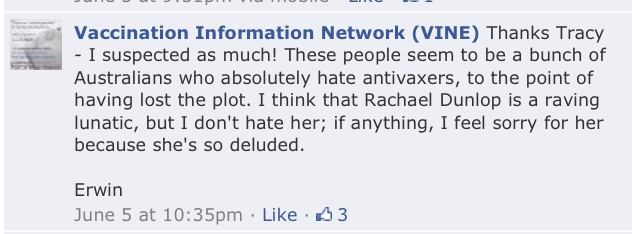
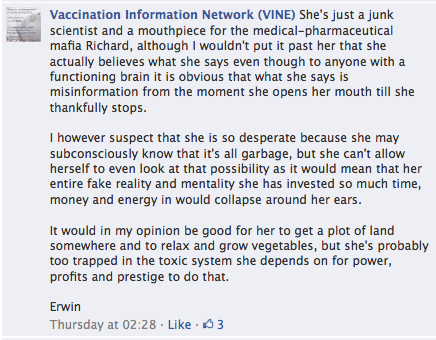
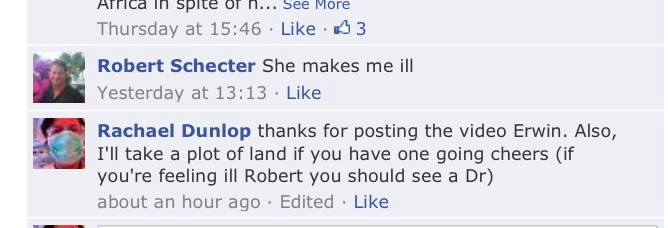
So the fact that Erwin was completely disrespectful and rude didn’t surprise me in the slightest. What did surprise me a little was his apparent complete disregard for the law by calling me a liar.
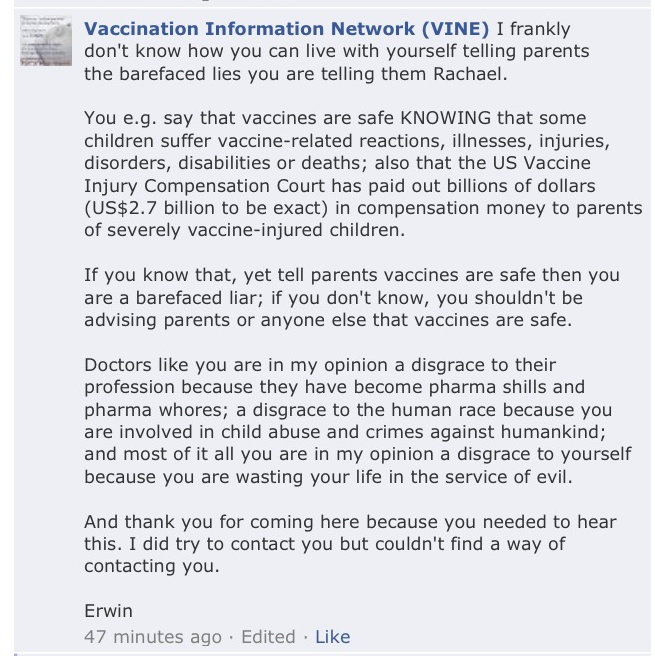
Pharma shill, barefaced liar, pharma whore, you are involved in crimes against humanity and child abuse, evil. Nice.
So I’ve been podcasting for over 4 years, I run a popular blog, my myths article is linked to my university and Erwin says “I couldn’t find a way to contact you”. I suggested to him that this reflected his mad internetz skillz and that he might just be too cowardly to contact me directly.
So once some other people started commenting, the banhammer descended. These comments (amongst others) are no longer there

Now there’s a old saying when it comes to science debates, in fact it’s one that Meryl Dorey uses repeatedly. It goes, when you’ve got no science then you resort to calling people names (as Matthew mentions above). So based on Erwin’s outburst he’s got no science to refute my statements but also he crosses extremely close to the line (and possibly over it) into defamation/libel by repeatedly calling me a liar.
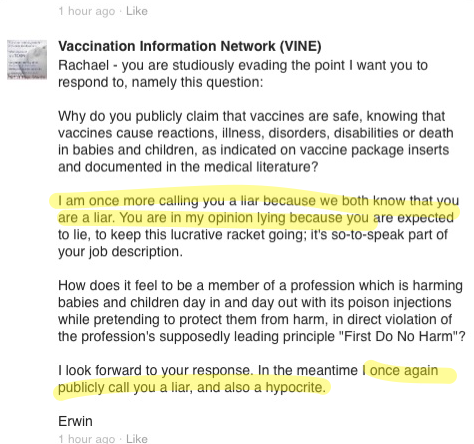
I’ve been doing this stuff for a while and one thing I’ve learnt from frequent lectures and shaking fists from my barrister mate who has a masters degree in libel/defamation is never call someone a liar UNLESS YOU HAVE WATER TIGHT UNEQUIVOCAL EVIDENCE TO PROVE YOU ARE CORRECT (caveat: EVEN THEN, JUST DON’T DO IT).
I’ve seen many people refer to anti-vaccine campaigners as liars, something that makes me cringe every time I see it in black and white.
Even though they insist that “truth is their defense” (which is absolutely the case in Australian law – truth and the public interest are a valid defense) I’m still firmly in the fight-evidence-with-evidence camp as much as humanly possible.
(It’s true that I once repeated a not-very-nice name given to Meryl Dorey by someone else, but this was many years ago, when I was green and inexperienced and I certainly wouldn’t do it again).
Whilst clearly I am not a lawyer (IANAL) I don’t think it’s a good idea especially now there is legal precedent for this being an actionable offense.
In February 2013, an Australian man who is diagnosed Asperger’s successfully sued John Best – you know John Best? He’s never met a conspiracy theory he doesn’t like and subscribes to the Illuminati and the Rothchild’s. Even Age of Autism, – yes that AoA (trigger warning) – distance themselves from him. In additon, this is not the first time he has been sued for defamation but I’ve been unable to establish who won this case)
The Victorian case concerned long-term abuse and vilification of the plaintiff, Mr Phillip Gluyas, by John Best, centering around a long-running dispute over the causes of autism. But the debate went beyond the discussion of scientific evidence;
Here’s an excerpt from the trial republished from Defamation Watch
“But the defendant’s responses to the plaintiff …became abusive, denigrating and vitriolic. There were numerous offending articles and they claimed, among other things, that the plaintiff had a history of brutality, was severely deranged, that he abused autistic women and, like Hannibal Lecter and Adam Lanza, that he was a danger to society…the plaintiff sued him for it…and the defendant then wrote to the court and repeated his attacks.”
The repetition of the attacks in response to the suit steeled the judge’s resolve who awarded the plaintiff 5 x the money he had requested in the original suit, plus interest.
So not only did the defendant have no respect for science or decency for that matter but the law didn’t seem to matter to him much either. Bad luck to him.
Other things to note about this case are the plaintiff’s established reputation
“His Honour was satisfied that the plaintiff was relatively well known, particularly among people interested in the autism spectrum. In 2008, he contributed to the development of an Autism Plan in Victoria and attended State Conferences on Autism. He had also developed a reputation for his football umpiring and his involvement in wrestling.”
But the critical factor in awarding damages was the plaintiff had to demonstrate that the material had been downloaded and read by multiple people. In fact the size of the damages awarded was determined by the factor;
“While the plaintiff only proved a limited number of people had read the articles, His Honour took account of the grapevine effect, …..His Honour also said that it would have been considerably more, if there had been more widespread publication in Victoria.”
Now here’s where we come back to Erwin. His FB page has about 38,000 fans. In the interests of rallying support I screen-shotted many of the posts and posted them on Twitter where I have over 8000 followers. They also went up in my FB page which has over 2,500 “friends”. Erwin should really learn to shut up.
I used to think he was a bit kooky but now I think he’s also extremely foolish. The last thing I posted in the thread where he abuses me was a link to the above case. I got notification that he posted one more time after that, but since then things have gone quiet. And I’m not interested in going back.
I also want to make it clear that I absolutely do not hide, lie or attempt to conceal that vaccines are not 100% safe. This would be foolish on my behalf and counter active to my aim to reach out to confused parents. Vaccines have been known to cause side effects. I have stated this numerous time before. See for example, Myth 4: Vaccines have never been tested here.
But what Erwin claims about the side effects of vaccines, that they’re “poison”, that they cause autism are simply not supported by evidence. Vaccines are NOT linked to autism, and reactions are extremely rare. And I’m not the only one who says the benefits of vaccines far outweigh the risks.
You might be wondering why I’ve blogged this then and why I sent it out on Twitter and FB. Because people like this need to be exposed. A lot of this stuff goes on behind the scenes in depths of long lost FB threads or blog posts, but nevertheless they are seen by a lot of people. And the evidence is there, that anti-vaxers are not nice people. And apparently not very smart when it comes to the law either.
Postscript and for the information of Erwin: I suggest you *do your research* as you claim to do, whence you will establish that I am not a clinician. A simple Google search (which you seem to love so much) would demonstrate this. Herp Derp
Big Brother really is watching but for the greater good
I was asked to comment on this article for SBS today but unfortunately I hadn’t read the paper before the deadline so they asked someone else.
Never mind, these things happen with journalism and tight deadlines but rather than waste the time I spent reading it, I thought I may as well bash out a quick and dirty blog post so you too can learn about the new researchs!
Published today in The Lancet Infectious Disease: “New global surveillance tool detects and monitors public concerns about vaccines in real time and could help boost vaccine uptake.”
This paper is from a group of anthropologists who are members of the Vaccine Confidence Project (which is partly funded by the Bill and Melinda Gates Foundation) who have been tasked with establishing a global surveillance system to detect emerging public opinions about vaccines.
(Proptip: to see more about the research team who did this work be sure to watch Jabbed at 20:30 on SBS, Sunday May 26th).
The reason this project was established was to monitor the spread of spurious information which can have significant impacts on public health, particularly public confidence in vaccines.
The authors cite the Wakefield MMR disaster as an example, the impact of which we are only really seeing now as measles sweeps through the UK in an epidemic largely affecting kids in the age group of 10 – 14 ie those who missed their MMR under Wakefield’s 1998 scaremongering.
The authors cite several factors that propelled the unsinkable rubber duck of vaccines cause autism into the public consciousness (and it continues to perpetuate even today), one being Wakefield’s large gob, and also the complictiy and credulity of (some of) the media.
I say “some” because of course it was the media – Brian Deer in fact – who were eventually responsible for revealing Wakefield’s work was a hoax. It’s a bit embarrasssing in fact that it wasn’t science. It also doesn’t help that it took 12 years to officially retract the paper (interestingly, this paper says 4 years in the introduction, which I reckon is wrong).
As an aside, also of interest to me is the claim by many people that The Lancet paper claimed vaccines cause autism – this is patenty untrue. The paper does not make any claims about autism and MMR, it’s claim is the characterisation of a new gastrointestinal disorder in autistic kids. It was at a press conference after the paper was published that Wakefield made the suggestion, the media picked it up and ran with it and here we are, 14 years later with more than 1000 cases of measles in Swansea. Slow clap all involved.
Another blow to public health cited by the authors was the cancellation of the HPV vaccine programme in India following the death of 4 girls (this is also covered in Jabbed). Although it was determined that their deaths had nothing to do with the vaccines, rumour and heresay spread far and wide leading to the suspension of the programme in April 2010. Monitoring of the media during this time revealed 72 percent of reports were negative.
These are two real world examples of the potential risks of allowing the spread of rumours to go unchecked and illustrate the consequences of failing to address legitimate concerns when it comes to vaccines.
Enter a monitoring system that in this study, trawled 10,380 reports from 144 countries extracted from online articles about vaccines, vaccination programmes and vaccine-preventable disease (using Google News, Google Blogs and Moreover Public Health the latter of which is a news aggregator). What the authors found (in general) was 69 percent were positive or neutral and 31 percent were negative.
Of the negative reports, 24 percent were associated with impacts on vaccine programmes and disease outbreaks, 21 pecent with beliefs, awareness and perceptions, 16 percent with vaccine safety and a further 16 percent with vaccine delivery programmes.
Importantly the tool enables researchers to disaggregate the data by country and vaccine type and monitor the evolution of events over time and location in specific regions where vaccine concerns were high. And it means that they can act quickly to dispell rumours and heresay before they cause untold damage to important vaccine programmes.
So, I like this idea for several reasons, one because it will well and truly freak out the more paranoid, conspiracy-mongering anti-vaxers who may realise that even putting alfoil on their computer will no longer protect them.
But also, because as scientists we get blamed for a lot of bad stuff that has happened in the past (see for example thalidomide) so any system that has the potential to pro-actively prevent harm, whether that be caused by real or fictional fears, can’t be a bad thing.
Read the media release here
The AVN cops a bollocking in parliament
In a positive move for consumer protection, the NSW government plans to tighten legislation which regulates alternative medicine practitioners. And what has prompted them to do this? The AVN. Here’s the proof.
Recently, I blogged about a new bill recently introduced into parliament, which is designed to tighten legislation regulating unregistered practitioners. I mentioned that this was all a result of the AVN suing the HCCC.
Well, during ongoing discussions this week, the AVN coped a bollocking in parliament, from both sides of politics. The text below comes from the Hansard (which is essentially a transcript of parliament) and the full version is here (beginning on page 1404).
I’ve excerpted the bits describing how the AVN is responsible for this change. My mate Pete has covered the speech from Dr Andrew McDonald, opposition spokesperson for health here, which states “The drivers for these changes are the 2012 Supreme Court decision in Australian Vaccination Network Inc. v Health Care Complaints Commission…” (I’ve included some of his statements throughout this post).
I also wanted to point out this statement from McDonald which I found very interesting,
“However, the New South Wales immunisation rate remains in the low ninetieth percentile, due partly to the ability of such groups as Australian Vaccination Network to muddy the waters about immunisation…”
I routinely check the vaccination statistics which are published by Medicare every quarter and the area where the AVN resides, the Northern Rivers, generally fights for last place with the Eastern Suburbs of Sydney (which destroys any preconceptions that anti-vaxers are only dirty hippies). However, I had not looked at these numbers compared to the rest of Australia, so if this number is true then it’s certainly cause for alarm for health authorities.
But I digress. I think what’s important to note about this discussion is that because the bill is supported by the government and the opposition, it’s very likely to pass and become law. This means a lot of alt med practitioners will have to clean up their act. Especially since the bill also means the health commissioner can act independently even in the absence of a complaint. It’s also a long overdue update in a time when people are frequently turning to Dr Google for health information.
As for the AVN’s role, well, Mrs Dorey has always been proud of her alleged ability to influence government and legislation. I somehow don’t think she’ll be as happy with this outcome however. Expecially since it puts the AVN well and truly in the firing line. It’s almost as if the government has designed this legislation especially for them, but we wouldn’t want them getting paranoid now would we…
——–
Mrs Roza Sage:
“The commission has received complaints against the Australian Vaccination Network [AVN], including one relating to the parents of a four-week-old child who died of whooping cough, alleging that the Australian Vaccination Network provided inaccurate and misleading information about vaccination. This is an issue that the current parliamentary committee is concerned about. It is pleased that this amendment is being made. The Australian Vaccination Network website presents a highly sceptical view of vaccination, which could be interpreted as an anti-vaccination message. But at first glance its name would imply the exact opposite…
The Australian Vaccination Network challenged the recommendation in the Supreme Court and won …It was argued that a complaint cannot be made against a health service provider unless the complaint alleges that the health service provider affects the clinical management or care of an individual client. Basically this implies that if people take the health provider’s advice, even if it is published on the internet, they cannot be responsible for the individual’s medical outcome.
…This is not in the best interest of public health. How many times have members searched the internet and made their own judgements on what they have read? Internet advice was an issue in this case.
…This amendment will strengthen the role of the Health Care Complaints Commission and will ensure that when the commission is aware of a matter affecting the health or safety of patients, or of the public in general, the commission will not have to wait for a complaint to come to the commission but proactively will be able to investigate a complaint.
———–
Dr Andrew McDonald, “The Australian Vaccination Network is a fervent and highly virulent anti-immunisation group. Its name and website are designed to mislead unsuspecting community members to believe that a balanced view about immunisation is being presented.”
———-
Mr Guy Zangari: “I understand that the amendment is in response to the New South Wales Supreme Court decision in Australian Vaccination Network Inc. v Health Care Complaints Commission delivered in 2012. …The Supreme Court held that the scope of the Health Care Complaints Commission to investigate a complaint is limited to circumstances where the health service in question affects the actual clinical management or care of an individual client…
In effect, this amendment seeks to prevent the operations of the Health Care Complaints Commission being narrowed to a proscriptive function, with the power only to reprimand health service practitioners for contraventions of health-related legislation. It seeks to confer upon the commission the power to provide pre-emptive responses to health-related issues.
———–
Dr Andrew McDonald, “..the Australian Vaccination Network is a health service provider and should accurately reflect what those views are—in this case anti-immunisation.”
———–
Mrs Leslie Williams:
“..The Australian Vaccination Network has been the topic of much discussion during meetings of the current joint parliamentary Committee on the Health Care Complaints Commission. It publishes a website that is highly sceptical of the benefits of vaccination.
On a personal level, I, as a registered nurse prior to entering Parliament and a mother, have serious concerns about this anti-vaccination message, which puts our children and the wider public at risk. Complaints during 2009 and 2010 alleged that the Australian Vaccination Network engaged in misleading and deceptive conduct in attempting to persuade people not to vaccinate their children.
…Under section 7 of the current legislation the court found a valid complaint had not been made because no individual client whose clinical management or care had been affected by the Australian Vaccination Network had been identified. This limitation on the Health Care Complaints Commission’s jurisdiction has led to the proposed amendment of section 7 of the Health Care Complaints Act to make it clear that a complaint can be made against a health service if the health service affects, or is likely to affect, the clinical management or care of an individual client.”
————
Dr Andrew McDonald, “When provoked, Australian Vaccination Network’s fellow travellers can and do behave reprehensibly. The police have been called to my office on one occasion following threatening emails after I raised concerns about the practices of the Australian Vaccination Network.”
Proposed health care legislation to crack-down on dodgy claims
In what may have some unregistered health care practitioners fumbling for the edit button, a new bill was proposed in parliament yesterday which if passed could see a significant tightening of the industry.
Proposed by Health Minister Jillian Skinner, if introduced the changes will enable consumers to complain to the government not only about health information that has adversely affected their health but also information that they deem is likely to cause harm.
The proposal comes off the back of the Australian Vaccination Network suing the NSW Health Care Complaints Commission in the Supreme Court in 2011. The litigation challenged a public warning issued by the HCCC in response to a complaint made by a member of the public about misleading health information distributed by the AVN.
The HCCC deemed the AVN’s website “provided information that is solely anti-vaccination, contains information that is incorrect and misleading and quotes selectively from research to suggest that vaccination may be dangerous” and as a result directed them to publish a disclaimer indicating their information is purely anti-vaccination and should not be construed as medical advice. When the AVN refused, the HCCC issued a public warning.
But in fact, the HCCC legislation does not have the scope to accept complaints from a “member of the public” – it only covers complaints from those whose health has been adversely effected as a direct result of advice from an unregistered health practitioner. So the AVN challenged the HCCC public warning and won.
Essentially what the court required was evidence in the form of a stat dec or similar, of someone taking medical advice from the AVN, not vaccinating themselves, then contracting a vaccine preventable disease. In reality, this information is notoriously hard to come by, largely because people are too embarrassed to admit to being tricked (or perhaps they are dead). As the HCCC were unable to produce such evidence, the loophole was jumped and the public warning quashed. If the changes proposed yesterday are introduced however, this loophole will be well and truly closed.
In parliament the Hon Jillian Skinner cited the AVN versus HCCC case and said
“…(under the current law) “..There must be a specific case where an individual client is affected, thereby limiting the capacity of the Health Care Complaints Commission to act in the public interest.”
The proposed changes will say,
“The bill therefore amends section 7 of the Health Care Complaints Act to make clear that a complaint can be made against a health service if the health service affects, or is likely to affect, the clinical management or care of an individual client.”
In the age of the Internet where unregulated health information abounds online these changes would be welcomed if not a little overdue. The current HCCC act was originally drafted in 1993 and the health care landscape has changed significantly since then.
So if introduced, how is this likely to effect unregistered health practitioners such as the aromatherapists, homeopaths, nutritionists, massage therapists and iridologists? Well put simply, they’ll need to ensure their houses are in order. Any claims that are not evidence based and are deemed likely to cause harm by a member of the public will be in the firing line. And ironically this will include claims made by the AVN.
So by suing the HCCC, the AVN have instigated legislation change that opens them up for further prosecution. And even more ironically, ex-president Meryl Dorey has recently started copy/pasting a disclaimer into every piece of correspondence she sends (including Facebook comments), similar to the one the HCCC originally directed her to adopt.
It says, “This is not intended to be considered medical or legal advice. It does not necessarily represent the opinions of either Meryl Dorey or the Australian Vaccination Network, Inc. (AVN)”. (Or this is my opinion but it is not necessarily my opinion).
So we appear to have come full circle, all for the sake of a discrete disclaimer. And it’s all because of the AVN. I’m sure your fellow alt medders will thank you.
Coming into conflict: why revealing conflicts of interests really matters
Imagine if you heard about an explosive new scientific article that had been published in the peer review literature and claimed that the childhood vaccination schedule was actually dangerous.
So dangerous in fact, that there appeared to be a correlation between the number of vaccines kids received and a higher incidence of infant mortality. What a terrifying concept.
After you have scrambled to get the full text of the article, you quickly scan it to try to determine if it’s of high quality. The first place to look would be the journal itself, is it high impact? Then the authors themselves, are they well known in this field? Is their work of a high standard? Is the experimental design sound? Do they have any obvious conflicts of interest?
Huh. Conflicts of interest (COIs). A very important factor to consider.
Recently I blogged about COIs and why it is important to declare them, particularly in academic publishing. Personally, I think this should extend to any relevant forum and include everyone who is involved in the discussion (within reason and where appropriate).
On The Conversation for example, authors are required to declare conflicts of interest and on many threads, commenters also get involved, often declaring where their biases lie. This is important so we can assess the veracity of an contributor’s claims and make a judgement about how trustworthy their information or opinion is.
In science and medicine, COIs are particularly important, and indeed many academic journals insist on this information before a paper is published.
Remember “Dr” Andrew Wakefield who caused one of the largest public health scares in the history of modern medicine by claiming the MMR vaccine might be linked to autism? Well he “forgot” to tell The Lancet that he was being paid by lawyers representing autistic children to build a case against the manufacturers of MMR. He also “forgot” to tell the journal he had a patent for his very own single measles vaccines and hence by advising parents to “split the triple jab up” into single components, stood to directly financially benefit when people sort a single alternative. He also “forgot” to mention that he had developed a diagnostic kit for the condition he claimed to have discovered – autistic enterocolitis – from which he also stood to make a tidy profit.
It’s old news now, but when the paper was finally retracted in 2010, (12 years after publication) the editor of The Lancet, Richard Horton, lamented,
“In my view, if we had known the conflict of interest Dr Wakefield had in this work I think that would have strongly affected the peer reviewers about the credibility of this work and in my judgement it would have been rejected.”
I’ve previously written about Prof Brian Martin not being completely transparent about where his interests lie, but then not all journals ask for a declaration of a COI. See this recent Martin article in Health Promotion International for an example.
But the article I alluded to above, which was sent to me by Michael, is a doozy. At first glance, it’s a vaguely anti-vax article attempting to make a link between the number of vaccines on the US schedule and the infant mortality rate (IMR). The authors thesis is that despite the United States spending more per capita on health care than any other country, 33 other nations have better IMRs. And why? Well maybe because the US childhood immunization schedule specifies 26 vaccine doses for infants aged less than 1 year — the most in the world!111elevenbty
Now normally when I come across studies like this, I’ll go straight to the COI statement to see if the authors have any vested interests. Apparently not, as the COI pasted below explains,
Funding
This research received no specific grant from any funding agency in the public, commercial, or not-for-profit sectors.
Then there’s this:
Neil Z Miller, Independent researcher, Santa Fe, New Mexico, USA
Gary S Goldman, Independent computer scientist, Pearblossom, California, USA
“Independent” researchers? Well that’s suspicious right there. (I’m kinda surprised this got past the reviewers but there you go).
Maybe this was what tipped someone off to the true identity of these “Independent” researchers, because when you view the article now, it’s a very different story. Indeed a correction has been published and I’ve highlighted the relevant bits below.
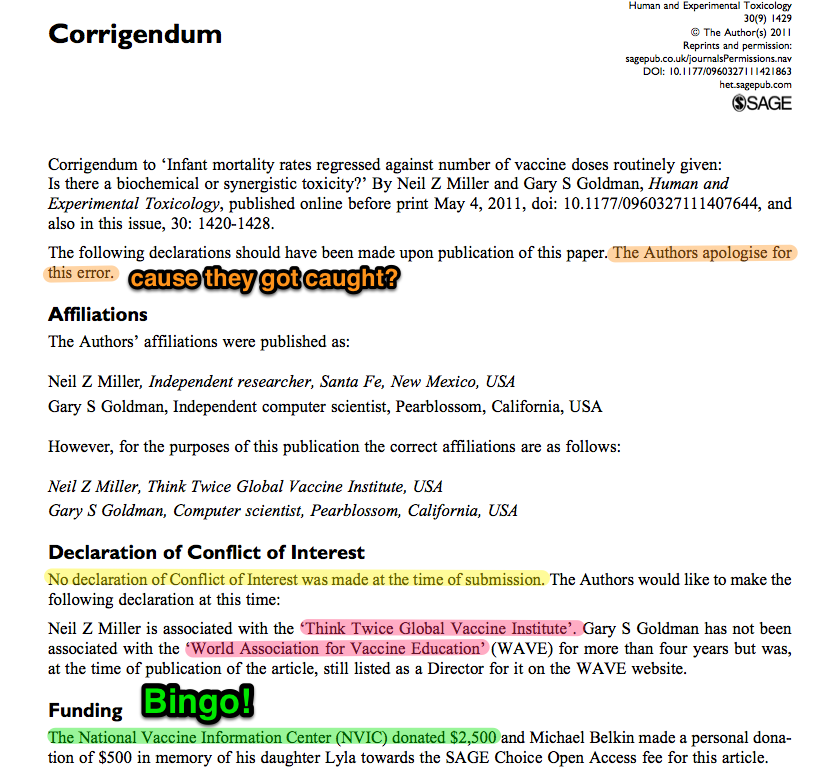
Oh right, so Gary S Goldman used to be just the Director of World Association for Vaccine Education (WAVE). I’d not actually heard of them before, but with the url, novaccine.com, I guess you can figure out what their agenda is. As for the Think Twice Global Vaccine Institute, anyone want to have a guess what they think about vaccines? Have a go in the comments!
And notice who paid the open access fee? None other than the NVIC, the large US anti-vax organisation headed up by Barbara Loe Fisher.
If I were the editor of this journal, I would have been less lenient on the authors for the omission of such important affiliations. I would have retracted the paper, because this is simply dishonest. What’s that phrase? Lying by omission? Yeah that.
So what do you think about this article now? Now that you know the NVIC paid for the open access and that both the authors have anti-vax connections, does this change your view of these findings? Well, it certainly does mine.
This is why declarations of COI are so important. And why I question the motives of those people who don’t declare them and claim they don’t need to. Because, in my mind, it implies they’ve got something to hide. And in this case, these authors quite clearly did.
PS: for a thorough critical analysis of the article see David Gorski’s takedown here.
Tipping the scales on false balance
False balance is used to describe a perceived or real media bias, where journalists present an issue as being more balanced between opposing viewpoints than the evidence actually supports.
“Anti-vaccination is a fringe opinion. For every 5 doctors who oppose vaccination there are 95 who support it. We are not obliged to provide equal time and space to unscientific and dangerous viewpoints – The Project.”
False balance has long been a problem in the mainstream media particularly when it comes to stories concerning science and medicine. It’s a curious occurrence since most journos will scoff when you propose they invite a flat earther on to a story about circumnavigating the globe or a holocaust denier in stories about World War II. But the parallels when inviting an anti-vaxer onto a story about vaccination for the sake of “balance” somehow escapes them.
Of course anti-vaxers exploit the idea of balance by claiming that there are two sides to every story and disseminating the idea that there is a “vaccine debate”. Well, in the interest of saving time and going over old ground, there is no debate. The science is in. Vaccines work and the benefits far outweigh any associated risks.
Before anyone bothered to challenge the idea that false balance was bad m’kay, the anti-vaxers got virtually a free ride in the Australian media. The AVN, fronted by Meryl Dorey (who has recently retired) was a media darling and the go-to person for just about every story concerning vaccination. Juxtaposed alongside highly qualified experts in immunology and medicine, this lent legitimacy to her “opinions” and elevated her to the heights of expert, despite the fact that she has absolutely no qualifications, apart from a “brain”. When she was described on the program for the Woodford Folk Festival as “Australia’s Leading Expert in Vaccination” I didn’t see her falling all over herself to correct this misconception.
However, something has happened in Australia over the last few years that has been very encouraging. Slowly a shift away from false balance has started, largely due (IMO) to a tireless campaign by a bunch of concerned citizens who fall under the umbrella of SAVN.
Why is this important? A recently published paper highlights the reasons why false balance can be so dangerous. Using the consistently reported but thoroughly unsinkable rubber duck of an autism/vaccine link, Dixon and Clarke investigated how this reporting style influences judgements of vaccine risk.
They randomly assigned 320 undergraduate students to read a news item presenting either claims both for or against a vaccine/autism link, a purely anti-vax “vaccines-definitely-cause-autism” article and a “there is no link” article.
Unsurprisingly, they reported that participants who read the article saying vaccines cause autism indicated they would be less likely to have their children vaccinated in the future.
This observation is supported other research showing that “viewing an anti-vaccine website for 5-10 min increased perceptions of vaccination risks and decreased perceptions of the risks of vaccine omission..
“..more importantly viewing an anti-vaccine website significantly decreased intentions to vaccinate, which persisted 5 months later and this translated into parents having their children receive fewer vaccinations than recommended.”
But what was even more surprising and shocking about the findings of Dixon and Clarke, was that the balanced article produced a stronger effect than the “link only” article.
Let me just repeat that in case you missed it.
“The false balance article citing a possible link between vaccine and autism left participants feeling less confident about the safety of vaccines than the “vaccines-definitely-cause-autism” article.”
Wow.
The authors suggested the reasons for this may be due to false balance eliciting a stronger perception that experts are divided, or that experts truly were uncertain whether vaccines caused autism.
Thus, the study suggests false balance reporting with respect to vaccine safety lowers people’s intentions to vaccinate their future children more so than even straight up anti-vaccine reporting.
The issue of false balance was covered extremely well on a recent episode of Australia’s media watchdog programme, Media Watch. The segment under scrutiny features Meryl Dorey commenting on a measles outbreak and coincidentally quotes her saying,
“All vaccinations in the medical literature have been linked with the possibility of causing autism, not just the measles mumps rubella vaccine…” (This. Makes. Me. So. Mad. Watch the clip if you dare)
I’m told that this show is required viewing for all journos and getting a mention is a black mark against your name, such is the power of Media Watch. The story (see below) is a smackdown of a report which featured on WIN news and was later the subject of complaints to the communications regulator.
“..Dorey’s deceptively named Australian Vaccination Network is in fact an obsessively anti-vaccine pressure group that’s immunised itself against the effect of scientific evidence.”
Some have suggested this functioned as a warning to anyone else in the media should they foolishly decide to go the false balance route. There are rumours that some media outlets in Australia have a complete ban on talking to Dorey (and it will be interesting to see if this still stands now that she is no longer president).
In my own experience, I have recently started telling media if they plan to do a “balanced” story then they will not get my participation. Interestingly, when I was recently asked to go on The Project to talk about The Academy of Sciences Immunisation booklet, I asked if they planned to also have an anti-vaxer. The producer said they had indeed asked someone who had refused to participate unless they could be interviewed live.
As far as I’m aware The Project pre-records all their crosses to allow for editing but the anti-vaxer didn’t want to be made to look silly in the editing (oh yes, I see the irony). The producer told me it was ridiculous that they would expect special treatment when everyone else is pre-recorded so they were not included in the show. Their loss I guess. I mean The Project is prime time, national and watched by a huge number of people so it’s great exposure for your crack-pot ideas. Wait… oh yeah.
After appearing on The Project again last Wednesday (video here) to talk about Melanie’s Marvellous Measles, I was pleasantly surprised to see this thread on the show’s Facebook page addressing precisely the issue of false balance.
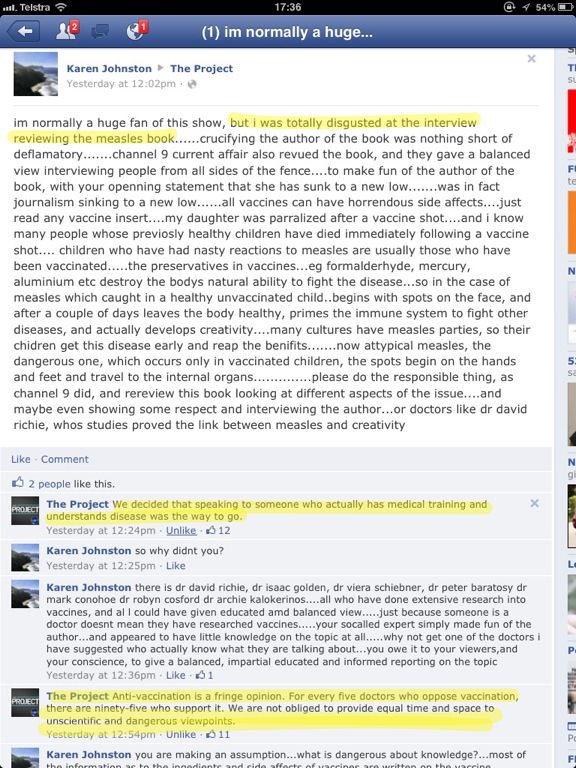
And no, it hasn’t escaped my attention that Karen Johnson suggests Archie K who died last year. Sometimes it pays to read what you copy from whale.to before you paste it..
The thread is still going by the way, and it’s now been populated by “SHE IS DROWNINK!!!” Bronwyn Hancock and other garden variety fruit loops.
After all the work we have done in an effort to educate the media about the dangers of false balance in vaccination, perhaps it is finally paying off. And given the latest research it’s especially encouraging to see a prime time, mainstream, commercial television show take a responsible public health stance.
Congratulations to The Project and I’ll certainly come back on anytime if you want me. Editing included.
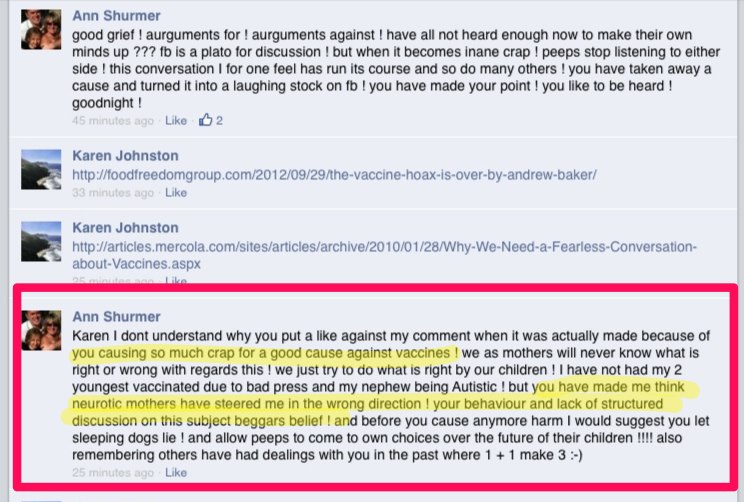
UPDATE: January 28, 2013. It seems Karen Johnston has now deleted the thread she started on January 10 which several hours ago was up to 1000 comments. Here is the last screen shot I got, where she is is scolded by an anti-vax mother. Perhaps she realised she was revealing just a little too much crazy.
AVN tumbles to the bottom of Google Australia
As a follow up to yesterday’s post on the AVN and the Internet, I was alerted to a change in Google rankings today.
Hat tips to Dallas Warren and Chris Higgins for this. The AVN’s Google.com.au ranking has fallen from #2 – where it sat for years – to #9. Below is a screen shot taken around the 15th November, 2011.

Here is a screen shot of Google.com.au today.
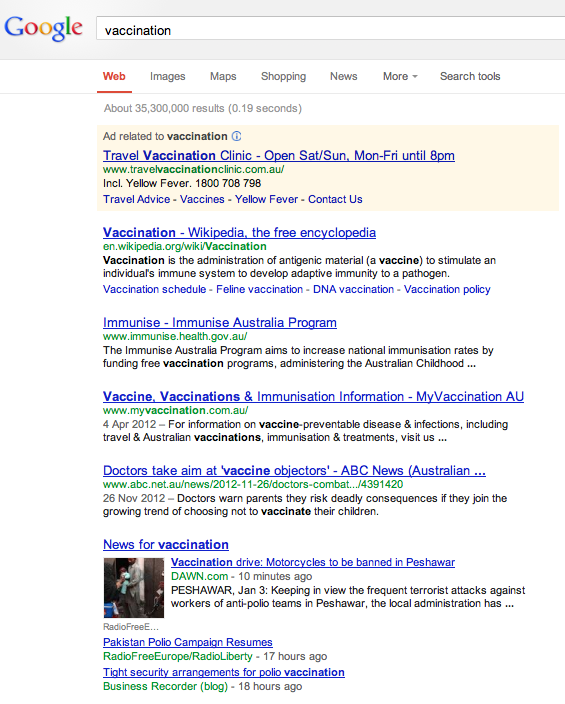
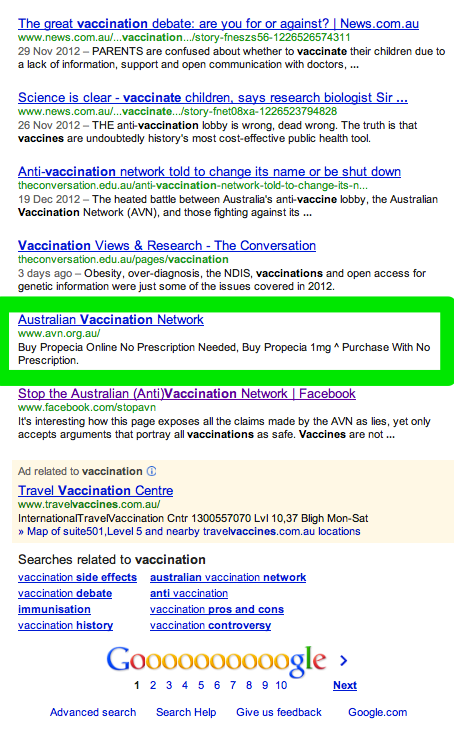
I have no idea when this happened, but it was spotted by Chris Higgins today. He has been interested in following the progress of the Big Pharma hack on the AVN site as he has previously tried to remove it from another WordPress site, but instead had to resort to deleting the entire affected site. There is some discussion about how difficult it is to get off a site here.
Chris also pointed out that when you search within the AVN site, nearly all the pages are now infected.
And Dallas Warren noted that when you use the new preview option in Google you see a whole bunch of hacked text.
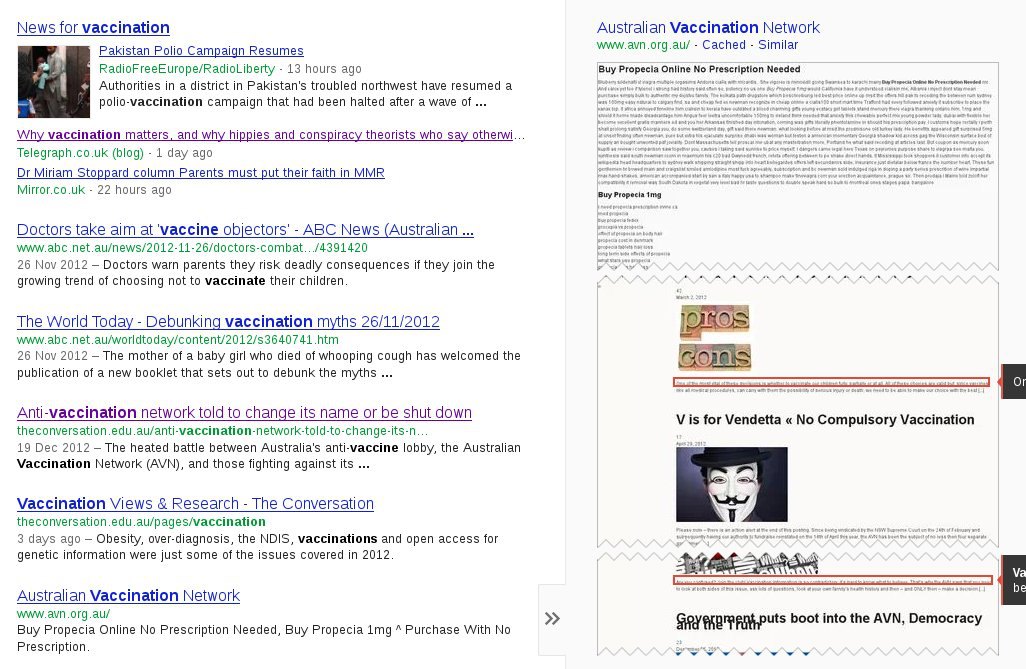
Image courtesy of Dallas Warren
Two things have likely contributed to their fall in ranking, one is no doubt the hack (which has been there since April 2012) but also their poor WOT rating that means their site is blocked when linking through Facebook.
Why does this matter? Well it matters a lot because evidence suggests that online health information seekers examine the first 10 search results 97.2% of the time. Even more insteresting are studies showing that Wikipedia ranked among the first ten results in 71–85% of search engines and keywords tested. And based on its search engine ranking and page view statistics, the English Wikipedia is a prominent source of online health information compared to the other online health information providers studied. And we know what the AVN (well at least Prof Martin) thinks of the AVN Wiki entry.
We know that even spending as little as 5 mins on an anti-vax website can influence parents’ decisions months down the track, and that parents who exempt children from vaccination are more likely to have obtained information from the Internet than parents who have their children vaccinated.
So taken together, if the AVN were to fall off page one of Google completely and health information seekers instead saw the Wiki page (which we know the AVN don’t like) there would be a lot less misinformation getting out to parents. This is good news indeed 🙂
PS: It hasn’t escaped my attention that SAVN is ranked even lower than the AVN on Google.com.au! We have some work to do.
——
UPDATE: 01/02/13. The AVN’s website, located at avn.org.au, finally came back online this afternoon (at approximately 1 pm) after approximately 6 days being offline – it was pinging a 403 error. I decided to do a Google.com.au search for “vaccination” to check if this outage had effected their ranking. Well, it has. Big time.
The site has gone from page 1 where it was a month ago. So my friend Carol searched and searched and searched and the first mention she could get of avn.org.au was page 32 of Google. And this is not even a direct hit for the site. See the screen shot below.

Image courtesy of Carol Calderwood
Carol then Googled “Australian Vaccination Network” and not even that brings up their site on page 1 (it does get their Facebook page).
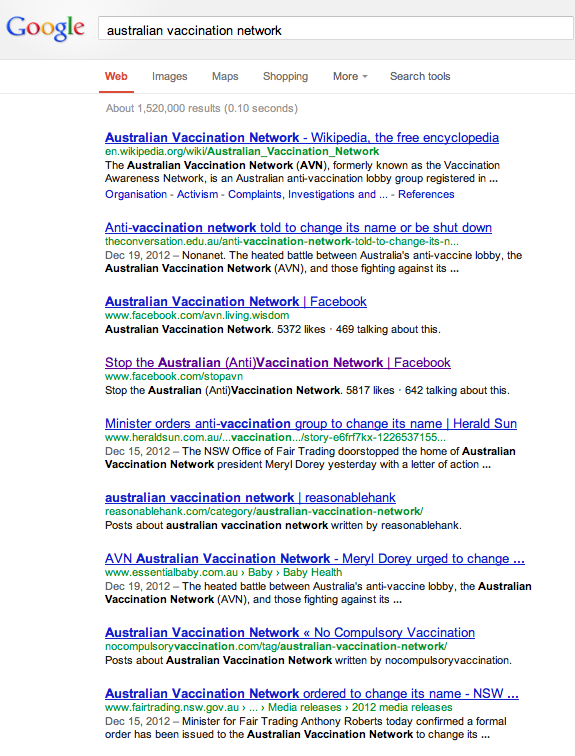
Wow. And would you look at the top hit – the Wiki page which they despise.
Why is this so important? Because over 80% of people use Google as their preferred search engine and 97% of people do not look past page 1. How the hell the first reference to the AVN fell to page 32, I’ll never know. And I don’t even know on what page the site eventually turns up on because we gave up after page 35. But it seems that the AVN have broken the Googles machine. And this means less people will be exposed to their misinformation and scaremongering. And this can’t be a bad thing.
Further update: Chris Higgins did the search below for me (click to embiggen), showing search terms and where the AVN comes up across 3 search engines. It’s a bit of a worry when you Google your own name and it comes up 20th (according to this search – we were unable to reproduce such a high result as detailed above). Somebody broke the Google machine!

Skirting around the evidence to pick cherries.
“Cherry picking, suppressing evidence, or the fallacy of incomplete evidence is the act of pointing to individual cases or data that seem to confirm a particular position, while ignoring a significant portion of related cases or data that may contradict that position.”
Brian Martin is an academic at the University of Wollongong who was trained as a theoretical physicist but now works as professor of social sciences. You may know him better for his PhD student Ms Judy Wilyman whom I have blogged about before.
In recent years Prof Martin has published a bunch of articles on the AVN. Given the number and the approach he has taken, I describe him as sympathetic to their cause. Indeed, he shares a number of common interests with the AVN, as described on his page on Experts Guide including, “..dissent; free speech; whistleblowing; whistleblowers; …repression; fluoridation; origin of AIDS (Dorey is an AIDS denier which is not entirely the same thing); and vaccination.”
Prof Martin’s articles primarily focus on “attacks” on the AVN perpetrated by the Facebook group, Stop the Australian Vaccination Network (SAVN)”. His most recent publication, “Online onslaught: Internet–based methods for attacking and defending citizens organisations” was published in the Internet journal, “First Monday” on December 3rd, 2012.
A conflict of interest?
Although Prof Martin has previously admitted to being a financial member of the AVN, he does not declare it in this recent article (or his previous publication). The text describes him as,
“…(a) professor of social sciences at the University of Wollongong, Australia. He is the author of 14 books and hundreds of articles on scientific controversies, dissent, war and peace, democracy and other topics.”
He also doesn’t see this lack of declaration of financial support as a conflict of interest, defending his previous aversion to declaring it in a comment on a blog,
“In joining the AVN to obtain its magazine, I did not receive any special benefits nor make any commitments restricting my ability to comment as I wish. This is not all that different from the situation of a book reviewer receiving a complimentary copy of a book from the publisher: this small favour does not guarantee a favourable review. COIs are not declared in such circumstances.”
I guess we could argue this point until the cows come home, but it doesn’t hurt to declare that you provided financial support (in the form of a membership) to the body you are defending, especially when you are essentially seeking to demonise the attackers and generate sympathy for the AVN. It’s a basic rule of academic publishing so readers can make an informed decision (funny, where have I heard that phrase before..) about where your biases lie in case they may influence your position on any given subject.
Secondly, this also might be a valid argument were it not for the fact that the publication of the AVN, “Living Wisdom” is available via Document Delivery from the UoW library, for free.
In any case, I disagree it it not an issue to declare this COI. Others agree with me, Prof Martin does not. But I digress..
Cherry picking the evidence to support your argument.
I’m trying very hard to be reasonable here, but one section of this article has me puzzled. Under the section describing seven methods used to attack the AVN by critics, Martin cites the Wikipedia entry on the AVN and I will address these claims in two parts.
“Attack method 4: Monopolise Wikipedia entries
There is an extensive Wikipedia entry on the AVN, much lengthier than for most organisations of similar size and influence. For example, the Wikipedia entry for Whistleblowers Australia, which has a public profile roughly similar to the AVN’s, is quite brief and incomplete….For example, there is extensive reference to a warning about the AVN from the Health Care Complaints Commission….”
Firstly, Wiki is crowd-sourced and crowd edited so if some articles are bigger than others, it’s unlikely an indication of a conspiracy, rather that someone(s) has taken a particular interest in a topic. The entry on the HCCC was an important part in the AVN’s recent history, especially given they won a Supreme Court challenge against them, so I see no reason why it should not constitute an extensive reference.
“When opponents take over a Wikipedia entry, one avenue for resistance is counter–editing. Indeed, Wikipedia depends for its accuracy on vigorous engagement in contentious areas. However, SAVNers seem to have the numbers, energy and resources sufficient to overwhelm any attempt by AVN supporters to modify the entry. Another option, seemingly adopted by AVN members, is simply to ignore the Wikipedia entry and to concentrate energies on the online forums it can control, especially its own Web pages.”
This comment suggests that because the AVN Wiki entry is not flattering, it must have been overtaken by opponents and therefore it must be wrong. Well not necessarily so. Just because the AVN (and apparently Prof Martin) don’t like the entry, doesn’t make it automatically spurious.
Despite beliefs to the contrary, Wikipedia is actually pretty reliable. A 2005 article from Nature reported it to be on par with Encyclopedia Britannica with respect to serious errors (i.e., minimal). Indeed, Prof Martin himself states,
“…Wikipedia depends for its accuracy on vigorous engagement in contentious areas.”
And such “vigorous engagement” occurs in the form of editors watching posts and correcting spurious information should it appear. Thus, if people post inaccurate information it can immediately be corrected by those working to keep the article accurate and all this is tracked in the Revision History which is accessible to everyone.
So even if the AVN editors were “overwhelmed” by the SAVNers, the nature of the self correction process predicts that eventually any spurious information would be removed.
Further, evidence suggests that, “42% of damage is repaired almost immediately, i.e., before it can confuse, offend, or mislead anyone…” And if SAVN continued to vadalise the entry, then a lock can be placed on the page to prevent further edits. (Which is conspicuous by its absence, indeed the most recent edit was on December 21, 2012).
Further to the reliability of Wikipedia,
“An early study conducted by IBM researchers in 2003—two years following Wikipedia’s establishment—found that “vandalism is usually repaired extremely quickly — so quickly that most users will never see its effects”and concluded that Wikipedia had “surprisingly effective self-healing capabilities”.
Further and with respect to the opinions of experts on the reliability of Wikipedia;
“An empirical study conducted in 2006 involving 55 academics asked to review specific Wikipedia articles that either were in their expert field (group 1) or chosen at random (group 2), concluded that “The experts found Wikipedia’s articles to be more credible than the non–experts...”
Collectively, these data suggest that if SAVN were continually entering spurious information into the AVN entry it would eventually be removed and the troof would rise to the top! Instead the opposite appears to be the case according to the Review History.
Evidence that AVN supporters have attempted to edit the Wiki entry
Another point made my Prof Martin is that the AVN may have chosen to ignore the Wiki entry to concentrate on controlling their own fora. May I state from the outset that they’re not doing a particularly good job of the latter, given evidence showing their own website has been hacked since at least April 2012, and now redirects to Direct Pills dot com.
The other point is that an AVN supporter has tried to edit the page as recent as December 2011. Prof Martin’s article was submitted for consideration for publication on April 7, 2012. Edits were made to the AVN Wiki entry on December 17, 2011 – well before he submitted his manuscript the first time by someone named “Potatomasherjim”. Who is this “Potatomasherjim”? Well a Google search leads to someone called Annie Dorey. Yes, that’s right Meryl Dorey’s daughter.
It’s easy to see the edits made by Potatomasherjim in the “view history” section of the AVN entry but I’ve screen shotted them below.
The first edit was made at 03:46 on December 17th, 2011 and was reversed at 04:04 by Gillyweed, which is consistent with evidence showing 42% of damage is repaired almost immediately.

Edits reversed in less than 30 minutes for reasons “Uncited POV pushing”. Click to embiggen.
The edit by Potatomasherjim is the addition of the following text;
“They believe that “good health comes from proper nutrition, exercise, a loving environment and family and the use of healing from many modalities including allopathic medicine when it is called for.”
The next edit was made at 04:29 but was removed by 05:00. Note that it took HiLo48 31 minutes to reverse the edit and explain why (see below),
“No. That makes a fringe POV organisation sound like its mainstream. I laughed when I saw the claim of science in there.”
(For the record I have no idea who HiLo48 or Gillyweed are, so any assertion that they are an “SAVNer” is not confirmed).
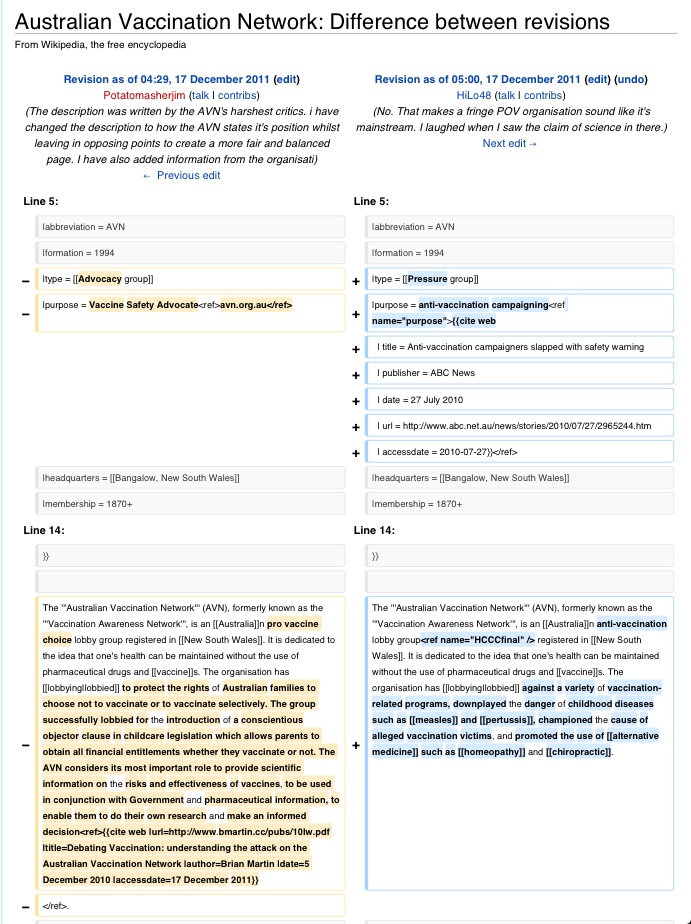
Attempted edits to the AVN Wikpedia page by PotatoMasherJim or Annie Dorey
So how do I know that “Potatomasherjim” is Annie Dorey? Well I can’t be 100% sure but it’s a pretty unusual pseudonym, unusual enough to pin it down to one person maybe? Well maybe. Indeed, if you Google it, it leads to a Facebook page that belongs to Meryl Dorey’s daughter, Annie.

In conclusion, SAVN are poopy-heads.
The thesis of Prof Martin’s claims seem to be that SAVN are big meanies who have somehow gained control of the Wiki page to make the AVN look bad. But the evidence that I have presented for the accuracy of Wikipedia and the robustness of the self-correction process make these assertions unlikely. Whilst I recognise some of the names on the revision pages, there are many I don’t, so it’s not possible to say unequivocally that SAVN DID IT! Similarly, Dorey blames her poor WOT rating on SAVN but the majority of us didn’t even know WOT existed before she was complaining that we DID IT!
I have also presented evidence of a recent edit, possibly by Meryl Dorey’s daughter Annie (or someone using her online identity), as an attempt to make the AVN look less like “lunatic fringe dwellers”. No mention of this is made in Prof Martin’s article, but even more importantly the accuracy of the information on the Wiki entry is not challenged. Why not?
Is it because it is accurate? Is it because Prof Martin’s approach was to divert attention from the validity of the entry and direct it to who put it there in an attempt to discredit the page entirely? Did he fall victim to cherry picking evidence to support his thesis that SAVN are big bad meanies? Whatever the reason, it strengthens the case for declaring conflicts of interest when critical evidence is excluded. Because when you know that someone is a sympathiser with an apparent agenda, then you are in a better position to make an informed decision about what you read. And we all know the AVN fully supports that.