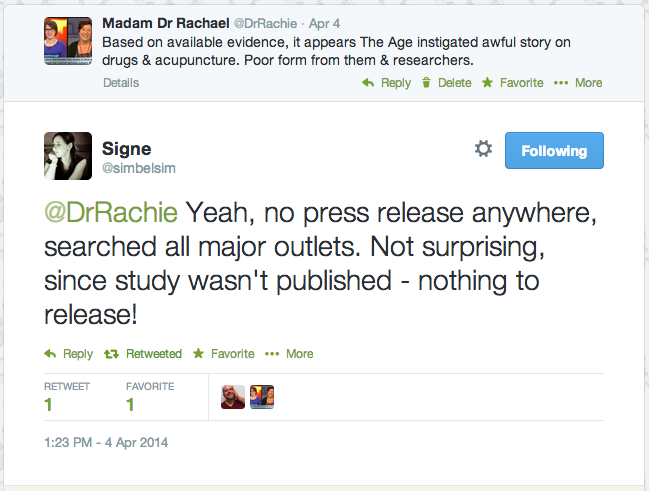
On Monday, I blogged about a “study” that purported to show that acupuncture was as effective as analgesics for treatment of pain caused by migraine, sprained ankles and lower back pain.
The problem with this “research” was it has yet to be published – indeed the news report announcing it said the results were not even completely analysed. Except for the fact that this was mentioned, the process of going directly to the press could be in breach of the Australian Code for the Responsible Conduct of Research.
Section 4.12.1 says, “Discussing research findings in the public arena should not occur until the findings have been tested through peer review. In discussing the outcomes of a research project, special care should be taken to explain the status of the project – for example, whether it is still in progress or has been finalised”.
Regardless, this represents very poor practice in my opinion, and I can only presume the researchers did this owing to the lack of critical controls (specifically, sham acupuncture or some other acupuncture control) in their 3 years $400,000 study, meaning they probably won’t get this published. At least not anywhere decent anyway.
Well, now I have an update. One of the researchers went on radio to talk about this, and his comments were like a bingo card of logical fallacies. I couldn’t bring myself to listen to the broadcast for fear of #stabby, so a very kind clever person transcribed it for me. So here dear reader, I present it to you, with my comments in parentheses.
Audio is here
BEGINS
Chris (Announcer): Now chronic pain is something many people have to deal with on a daily basis and it can be just as debilitating as anything they’re suffering.
Well a new study out of Melbourne has shown some very promising developments when it comes to pain relief, and it doesn’t involve any new drug.
The Chinese therapy of acupuncture is currently being put tot the test across four of Melbourne’s top hospitals as well as RMIT University; and before you roll your eyes at the idea, let me just tell you about the results, because so far the results have been pretty amazing!
The study is currently indicating that acupuncture could be just as good as those serious drugs we take to relieve pain. [NB study is NOT published, results still being analysed, thus these claims can not be made]
For instance, Panadeine Forte, Votaren even Valium which is quite a breakthrough in the area of acupuncture; could acupuncture be the future in pain relief?
On the line with me now is Mark Cohen from the Health Innovations Research Institute at RMIT University. Mark, welcome to the program.
M Great to be with you Chris.
C The results from this study, pretty promising so far?
M Well they are very promising [not analysed, not published], and these come on the back of a lot of experience [anecdotal, NB there is nothing wrong with instigating a study based on observations, this is how much of science happens, but especially where pain is concerned, you must have very strict controls in place to ensure you can differentiate between placebo and any effect. This was not controlled in this study] that we’ve had in Melbourne of Emergency Medicine physicians who have been trained in acupuncture an who have been using it in the Emergency Department with great effect, and then we decided, well let’s put this to the test, and we’ve compared acupuncture for migraine, back pain and ankle sprain to acupuncture plus drugs, or just drugs alone.
C Interesting. So tell me about just acupuncture alone? You think that it can give you pain relief equivalent to something like a Panadeine Forte?
M Well, in this study we showed that they are basically equivalent [no, you didn’t. There’s an old saying in science, if it’s not published you may as well have not done it] , so that there was no difference between Panadeine Forte, and not just Panadeine Forte, even opiates, things like Pethidine, and you know, harder painkillers we often get …
C Uh huh
M …in Emergency Departments
C What about when you put these two together? Acupuncture, and some of these harder anti-pain drugs?
M Well again, together we found that… and our results are preliminary [read: unpublished], but we together found that more effective than either one alone. But, er, with the way we do statistics, and we’re still finalising the statistical analysis, is at the moment what we can say is they’re deemed equivalent. So acupuncture was deemed equivalent to pharmacotherapy [not], which is a whole range of um drugs that are used, according to a protocol in each Emergency Department
C That’s very interesting, but can you please just explain to people; I know, I’ve had acupuncture on a couple of occasions in my life for a chronic back area that I have that, er, gives me a great deal of trouble…
M Uh huh
C ..but when I’ve had acupuncture, I tell you what, I’ve gone without a pain in that area for sometimes years. So I, I , I, would opt for acupuncture, um, if I got that pain back again. But just give people an idea of what acupuncture is and what it does.
M Well acupuncture, I mean, has been used for thousands of years [logical fallacy, argument from antiquity and also disputed], and it hasn’t just been used in China, a lot of different traditional medicines have what is called counter irritation, where you irritate one part of the body with a needle, or heat, or pressure, to relieve pain in another part. Acupuncture, modern acupuncture, involves usually disposable needles inserted in precise spots, and often the best spot to put a needle is the most intensely painful spot, so you put, you know, a few needles that vary on the condition and where the pain is that you’re trying to treat, into the body, often then you twiddle the needles, or you turn, and lift them up and down, and you get this sensation that the sensation that the acupuncturists call “Dead Chi”…
C That’s right!
M …or “A Chi” and it’s a feeling of numbness, and fullness, and distension, and a bit of soreness; it’s not quite like electricity, but…
C But it’s not always pleasant, I’ve gotta say Mark
M …it’s not entirely pleasant, but it’s not directly painful…
C No
M …more sore than pain, and it feels a bit forward, sometimes that feeling travels, you know, along the body…
C Yeah
M …but that feeling generally means you’re going to get a good result, and there’s, there have been a lot of animal studies that have shown that when you insert needles, acupuncture needles, you get release of endorphins and a lot of other neurochemicals which are your body’s own natural painkillers
C So you allow the body to take the pain away from the body?
M That’s right, so that you’re basically alerting to the body, alerting to the body, saying hey, something’s going on here, deal with it.
C How, how popular is acupuncture? [note: just because something is popular doesn’t mean it works. Plenty of people believe in an invisible sky fairy, doesn’t make it real. Your logical fallacy is argumentum ad populum]
M Well acupuncture’s very, I mean, China, and around the world it’s used very very commonly; even in Australia I mean most suburban areas would have a Chinese medicine practitioner practising acupuncture.
C Does your average GP think that acupuncture is a bit “witch doctorish”
M Well, no, I did a study about ten years ago asking GPs their opinion about a whole range of complementary therapies, and acupuncture was probably the most accepted, and about 20% of Australian GPs have some training themselves in acupuncture [again, argumentum ad populum], and acupuncture has had a Medicare rebate item since the early eighties, so, I mean, you get, you can get acupuncture on Medicare [doesn’t mean it works, you can also claim homeopathy on Medicare] when it’s done by a doctor, or, you know, you can get it done by a traditional Chinese therapy…
C So it’s interesting, if you’ve got chronic pain, and you’re taking drugs consistently, over and over again, it can’t do much for your kidneys or your liver, could it?
M Well, that’s right, and one of the issues is not just chronic pain, but what we tested acute pain in the Emergency Department, and the drugs that are used to treat pain, all have fairly serious side effects, and even Panadeine Forte, I mean they make you very constipated and nauseous, and often, when you’re giving an opiate drug, for example, you can’t just give an opiate drug, you have to give an anti-nausea drug at the same time…
C Yes, yes
M …and other drugs to stop you getting constipated, because then you get abdominal pain and bloating, so, the drugs themselves, and also in an Emergency Department you can’t just give someone a dose of opiates and then send them home, you’ve got to watch them for four hours because they’re going to be drowsy, and so there are serious side effects to the drugs, so having an alternative to drug therapy, that’s not a drug, is actually a great boon for many many patients.
C Yeah. Interesting. And so you must be excited by this, but there’s more to do?
M Well, there’s certainly more to do [like, er publish the results?], and, and um this is, we did this in four hospitals, there are two private hospitals, Cabrini and the Epworth, and two public hospitals, the Northern and the Alfred, and um, you know the results are the same across the hospitals [no way to tell with no acupuncture controls], now the question is, if, if acupuncture’s going to be delivered commonly in the Emergency Department, who’s going to deliver it, can we train emergency physicians to do acupuncture…[er, easy tiger, maybe you should publish the results first]
C Yeah, right
M …you know, do we bring in other acupuncturists, what level of training do they need, but, it’s it’s quite telling that in Australia I know at least three emergency physicians who have done their own training in acupuncture [is it? your logical fallacy is argument from authority], and Michael Ben-Meir, who’s now one of the, he’s now head of the Cabrini Emergency Department, now he’s a trained acupuncturist, and he uses acupuncture pretty much as a routine therapy for patients who come to Cabrini Hospital in Melbourne
C A great devotee, all right, good luck, and thank you very much, and well done with what you’ve discovered.
M Yeah, well thanks, Chris, um yeah it’s encouraging, and we hope, we hope you know hopefully this will help a lot of people who are in pain and um give them another option… [when it’s published, maybe]
C Yeah, absolutely. Thank you, Mark!
M It’s a pleasure.
C Mark Cohen from the health Innovations Institute at RMIT University. So maybe it’s not about taking drugs to get rid of that pain that you may have, maybe you’ve got to think outside the square and think about acupuncture, it’s not that witch-doctorish as you may think. We’ll take some calls on that.
[Calls are between DJ and public]
ENDS
I find this practice extremely unethical and irresponsible and the researchers involved should be ashamed. The media also deserves a slap upside the head, as described eloquently here by my colleague Mick Vagg. I’ve also submitted a letter to the editor of the paper who reported the study, penned with my colleague John Cunningham, and I will publish it here if it doesn’t make the Sunday paper.
I don’t expect we’ll ever see this research published, but it doesn’t matter anymore, the horse has has bolted. People think acupuncture works as well as drugs, based on some very questionable evidence.
In this broadcast, Prof Mark Cohen did not make it sufficiently clear that these results have not been published and that the correct controls were not used = bad practice and bad science.
Thanks to Steven Novella who also blogged this here